Resources
Hold Your Horses: Deliberate Data In A Fast-Paced World
This post is for those curious where the future’s heading, and wonder how we can navigate these rapidly-changing currents. It’s for those who’ve heard about what we’re doing at The Grid and want to know why make the case for deliberate data in a fast paced world.
Written By
Jonathan Knegtel
Date
Category
Insights
Length
This post is for those curious where the future’s heading, and wonder how we can navigate these rapidly-changing currents. It’s for those who’ve heard about what we’re doing at The Grid and want to know why.
This is a reflection on 2025 into 2026, and a statement about where we’re headed. It’s also an invitation to join us in rethinking how data, technology, and trust actually work in a world that won’t stop rushing forward.
In the Race for Good Data, the Tortoise Wins.
From the light-speed advancements of technology and AI to rapid societal and economic shifts across the globe, it can feel like the world is developing at an unprecedented pace. When businesses aim for hyper-growth and rapid acceleration, the fastest route seems the way to win the race. But the data and information that actually matters (the stuff that powers our lives, our businesses, and our societies) moves slowly. And that’s how it should be.
At The Grid, we’re all about deliberate data. In a world obsessed with speed, we’re choosing to move slowly, build with intention, and prioritize stability over hype. This doesn’t mean we’re resistant to change (far from it) but we’re making sure that the foundations of the house we’re building are solid, transparent, and trustworthy. Think of us as the Web3 version of the slow food movement: but instead of farm-to-table ingredients, we feed on data.
The Rising Cost of Good Data
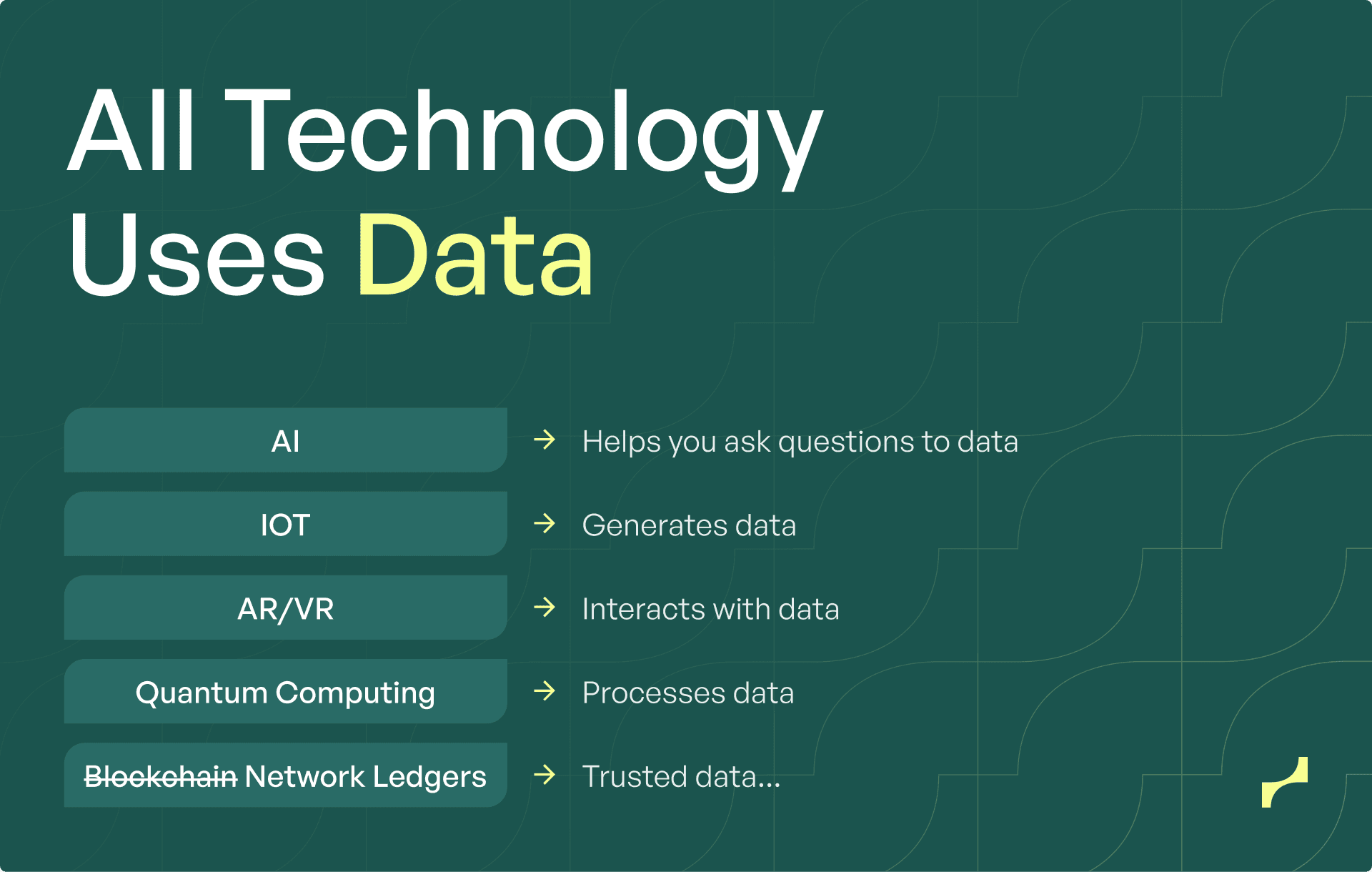
All technology uses data. The modern developments that are the subject of pretty much every tech article being published right now ( AI, IOT, AR & VR, Quantum Computing) all rely on data. Whether they’re sieving data, generating data, interacting with it or processing it, data is the lifeblood that keeps every system beating.
In this modern world, it feels like data is everywhere and getting cheaper. But good data is more expensive than ever. ‘Good’ data is accurate, unbiased, actionable data: the kind of data that requires care, and context, and systems that prioritize integrity over speed. The kind of data that you actually want and trust to be the driving force of systems, companies, and governments (and the world at large).
We believe that for a society to function well, it needs good data. It’s the foundation of informed decision-making, accountable systems, and trustworthy interactions.
Why Slow Data Matters
The information reformation has brought about technological revolutions, but instant access to knowledge doesn’t necessarily make us smarter: it just makes the room louder. Cheap data allows algorithms to prioritize engagement over truth, resulting in attention spans shrinking faster than the polar ice caps. The information that powers trends across social media is hyper-fast paced and, like fast-food, nutritionally void. We are buried in noise.
The information that we need to hear clearly, the data that underpins decisions; the records that hold us accountable; the systems that power our economies, cannot, and should not, move at warp-scroll speed. Because the costs saved in modern, rapid data production get pushed onto our most valuable asset: Truth.
Enter: Deliberate Data. Verifiable information built to last.
Deliberate Data stands in opposition to the viral, ephemeral, ‘move fast and break things’ energy that has dominated tech for way too long. Fast is your friend when you’re a fibre-optic salesperson, not when you’re dealing with things you actually care about. Deliberate Data isn’t about making things inconvenient: it’s about ensuring responsibility. Just as you can’t drive on freshly laid tarmac, you can’t rush trust without consequences.
So, in this world of constant chaos, deliberate data is our response, and our building material of choice. The data that we deal in at The Grid is hard to put on-chain, but by being deliberate, we’re building not just a map, but an atlas that is applicable to more than just our own ecosystem. In this rapidly changing world, it’s the only map that makes any clear sense.
With Change, Comes Decentralization
As noted in the 2025 ‘World Rewired’ report from JPMorganChase, ‘The global order is fragmenting.’ But crucially, it is ‘not collapsing.’ Rather:
Power is dispersing across regions, institutions are losing coherence, and universal rules no longer bind. Yet the system remains governable. The defining feature of this era is not systemic breakdown, but a more segmented order: cooperation endures in pockets where interests align, even as rivalry intensifies elsewhere.
So what does this all mean? The world is changing, sure, but there are new opportunities for collaboration. And the great advantage of technology (or disadvantage, depending on your side of the telescope), is that it can transcend borders.
The EU will soon roll out the Digital Product Passport (DPP), a mandatory digital record aimed at improving sustainability, traceability, and circularity. While these are currently focused on fast-moving consumer goods (FMCG), the concept they represent – providing transparent, accessible data to consumers, businesses, and authorities across borders – is important.
Initiatives such as the DPP have a clear benefit: keeping users safe. However, the underlying data is kept under wraps. While privacy is necessary, we don’t think good data should be locked behind walls.
That’s why at The Grid, we also provide open data, including via our API, making it accessible, auditable, and ready to power whatever you’re building. Because we believe data should be readily usable, systematically relevant, and communicated in a structured way.
And for the people building in Web3, we’re building feeds designed specifically for you. Feeds that show you how things change over time, help you to discover what actually matters, that connect you to people and organizations you trust – and cut through the endless noise of social media. Your feed should read like a clear signal, not static.
Carlota Perez and the Broader Context of Technological Change
Technology isn’t just about innovation. It’s about integration.
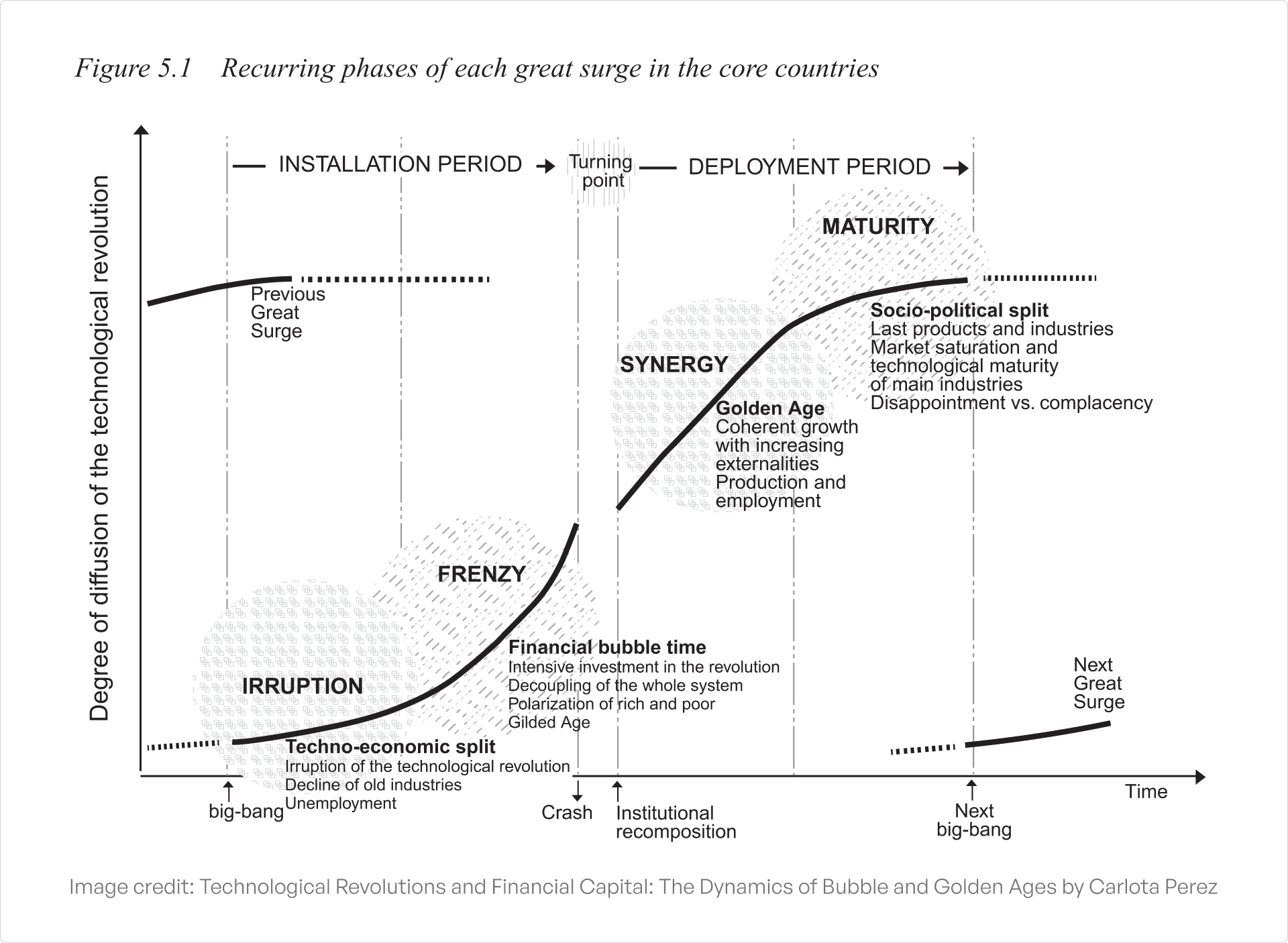
Image credit: Technological Revolutions and Financial Capital: The Dynamics of Bubbles and Golden Ages by Carlota Perez
By looking at the ‘Technological Surge Cycle’ of the economist Carlota Perez, we can see how technological revolutions integrate into society. Change doesn’t just happen through or because of the technology itself: what matters is how that tech changes the way we live, work, and interact.
There has been a fundamental shift in how we record, verify, and exchange value. Data is now generated by IOT, filtered by AI, interacted with by AR/VR, processed by Quantum computing, and verified by Blockchain. The revolution may not yet be fully loaded, but Network Ledgers are at the foundation of it. And as we move into this new, cross-border era, when it comes to the key use of information, Blockchain should be underpinning our trust in these systems.
In the context of the Surge Cycle, deliberate data isn’t just a technical approach: it’s a societal necessity. If we want to move into the recovery and deployment phrase, we can’t just have the technology. We also need a clear understanding of what’s new, what’s changing, and what’s been changed. Because when a software update can break your entire workflow overnight, or you’re dealing with infinite variations of a workflow, transparency isn’t a nice addition. It’s essential.
When it Comes to Data, Transparency is Key
When it comes to blockchain, transparency and verifiability is everything. But when it comes to companies using blockchain? The visibility gets a bit less clear.
In companies of times past, software was run on company premises, on actual servers that employees could physically touch, and lock away each night. But now, when you use an app or service, it connects with a multitude of other servers and companies across the globe, almost instantaneously. On average, organizations use over 100 apps, with enterprises using even more. But there’s one fundamental challenge to this way of working: how can organizations know if an app is trustworthy? And the opportunity we see, what happens when they change & make updates?
Without the transparency of underlying data, it becomes hard to see the trustworthy-wood from the trees. Take, for instance, the confusing world of ecosystem pages & wallets. Currently, it’s very difficult to determine whether an app is really from the company/developer it claims to be, or whether it does what it says it does, and these pages and wallets are often very light on info. In mobile App stores, we trust Apple and Google to do this for us. But this is for consumer apps. What about crypto projects, protocols, dApps and assets?
If we’re going to use crypto organizations and business, we need to understand, and be able to reference, how they work, what they integrate with, and if they are even real companies. If we imagine a future in which there are increasing numbers of app stores (or, for crypto, no-app stores) transparency in the way information is distributed is critical. We need to have clear access to the data which tells us who they are, how they operate, what their latest updates are, and for this to be accessible in the places where users already are.
In current app stores, when a product changes, and new features are added, these updates are still communicated in a way so old-school, it’s almost analog. We see social media posts communicating fluff, blog posts (which people read less and less), account managers ringing up potentially interested parties, and generic emails sent out en-masse. It’s not efficient.
The current trend of using AI to repeatedly scrape the internet for scraps of information is also not a long-term solution. Despite the deceptive efficiency of automation, this is actually the least efficient way of solving the data transparency problem, and wastes compute and credits across all of us, burning fuel and money to produce poor quality data.
However, when changes happen in the context of deliberate and slow-moving data, we get fewer, but more focused and meaningful updates. These are communicated in a structured way, ready to be picked up by their audience, and passed onto the relevant person or system as needed.
The Future isn’t About What’s Next, it’s About What Lasts
In 2026, The Grid is still early in its journey. But our route forward is clear.
We’re focusing on the infrastructure that powers the future, not the trends that fade with the next news cycle. So, if you’ve been wondering why we’re not interested in rapid growth or speed, here’s our answer. We’re not here for sprints. We’re not running a mere marathon. We’re here for the data equivalent of the Tour de France: multi-day, multi-stage, and across multiple countries.
We’re here to build a new foundation. And foundations, by definition, take time.
So you believe in deliberate data, the importance of transparency, and systems that put trust first – here’s your open invitation to join us in building for the long-term. Whether you’re a builder, a thinker, or just someone tired of the chaos, we’d love to hear from you.
To read more about our ethos of why this data is important to us, see Move Slow, Break Nothing by our Co-Founder/COO Jordan Hatcher.