Resources
The Grid is the Directory: Mapping the Future of Web3
Wanting to find what you’re looking for: it’s a fundamental human need. But when it comes to data, there is no big filing system in the sky.
Written By
Jonathan Knegtel
Date
Category
Insights
Length
Maps Start with Directories
Wanting to find what you’re looking for: it’s a fundamental human need. But when it comes to data, there is no big filing system in the sky.
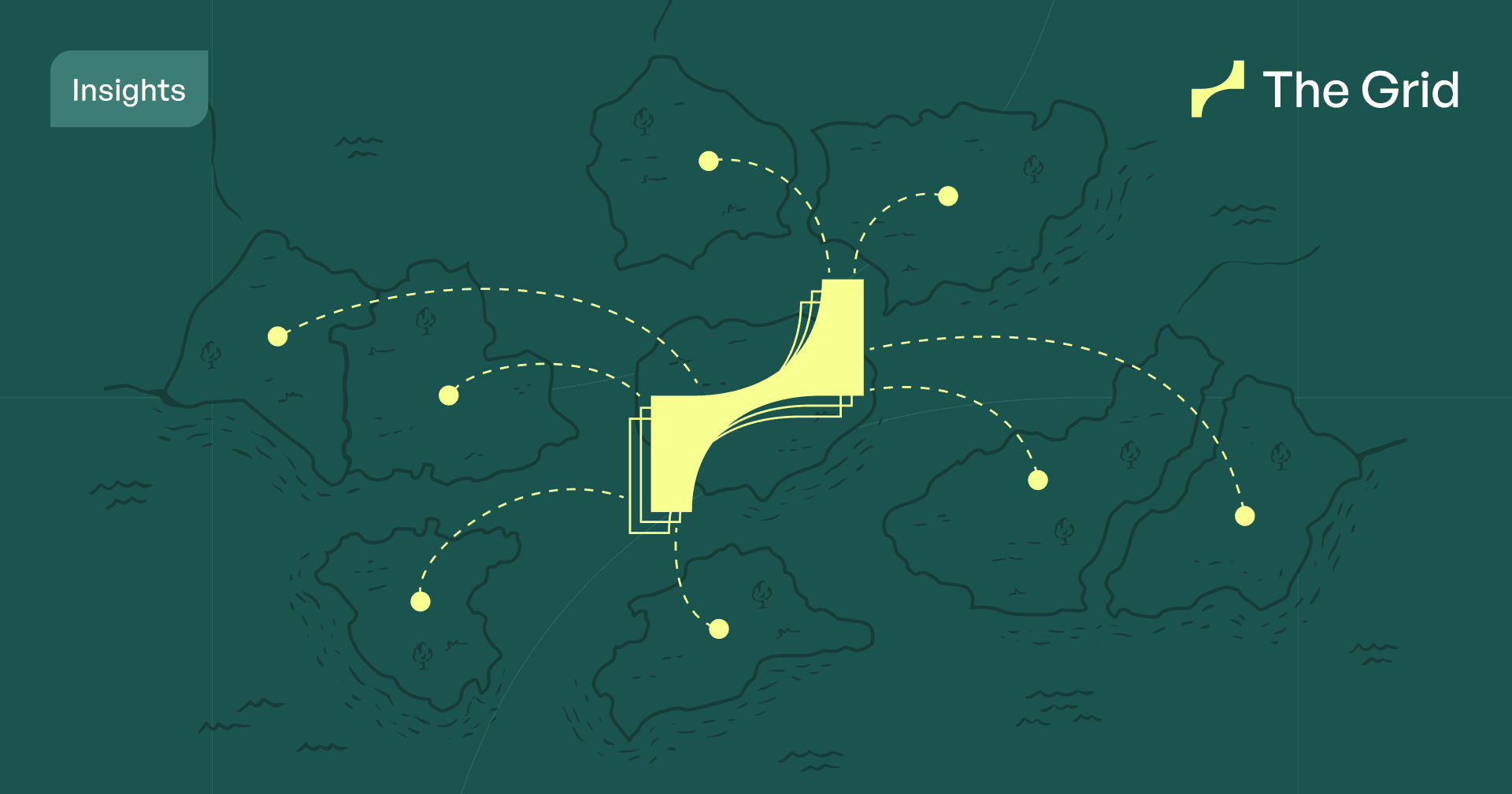
If you want to find an unfamiliar location, you need a map to get there. Over centuries we’ve graduated from paper maps and the A-Z Street Atlas to Google Maps and speciality navigation apps like Waze. Today though, when it comes to Web3 or even SaaS, we still don’t have a good solution. For the Web3 city, a metropolis still under construction, there is no conclusive map – and not all of us have the tech equivalent of a London cabbie’s Knowledge.
Why does this matter? Without a clear directory, searchers waste time, resources, and often end up down dead-ends or side-roads. They might not find what they’re looking for, or not know that a better solution exists.
Within the ideal directory, what you seek for, you should find. It should be well structured, organized, and accurate, so that you can see how what you are looking for fits into the wider whole, and know that the results can be trusted. It should be somewhere that generalists can go to and find a specialist; where people or AI can find what they didn’t even realize existed.
What might the ideal directory for Web3 be like? At The Grid, we’re trying to make it like us.
In this article, I explain how The Grid is developing this directory, our considerations in building it, and why good maps matter to enable greater migration to the Web3 space.
Results Need to be Trusted
I’ve written before about the need for good, deliberate data. But why does this matter in terms of compiling a directory?
If you’re searching online you want to be able to trust the source. You don’t want to be that person on Facebook Marketplace searching for a place to live and getting scammed. If you don’t know where to find what you’re looking for, you’re more likely to stumble upon unverified sources of information, and more vulnerable to being taken advantage of.
The Grid acts as a verification system. Think of it as a (much better) blue tick on X. All the resources on the directory have been approved and checked. We want to build a platform for communication that inherently keeps out the bots and shit-posters. The AI death-spiral doesn’t only apply to content: if a directory is compiled using only AI data, it’s not going to be accurate or consistently useful. Anyone who’s ever taken an Uber instead of a local taxi, and encountered an out-of-town driver relying, inefficiently, on the app’s map, will know the frustration of reliance on automated data over experiential.
At The Grid, we only deal in good, deliberate data, which is validated and aims to be up-to-date. When we’re talking about a directory for something as ever-changing as Web3/Blockchain, it needs to be constantly and accurately updated. We don’t want to deal with static – of the noise or stillness variety.
Some people think this can be solved with AI, but the issue with AI product recommendations is that they’re not able to immediately adapt to evolving solutions to a problem. Google Maps should not suggest restaurants that have been closed down, or say that a shop is open when it’s actually closed for a bank holiday. And as a business owner, you want to be represented correctly on such maps.
This is why The Grid’s is moving towards a Data Maintenance system that quickly and proactively finds updates of listed profiles, making it a useful, live directory. Data should be reflective and responsive, hence why our schema, TGS, is constantly growing, improving, and iterating: if a city doesn’t adapt to the lives within it, it very quickly crumbles.
With The Grid, we have a “write once, read everywhere” policy. You can see your full edit history, in the same way that you can see transactions on a blockchain. Every data edit is checked by both AI and a (real life human) pair of eyes, to ensure data quality, but the process is smooth and swift – and importantly, accurate. Data cleaning isn’t particularly sexy work, but this process of checking and confirming results in far higher quality datasets. It’s a premium service which delivers reliability against more and more untrustworthy AI information.
Other platforms only offer ‘un-structured’ updates. For instance, if you post product information to LinkedIn, that data remains isolated to LinkedIn. You can link to a blog post on your own website to explain this information in more detail, but it’s still really unstructured.
In the world we’re mapping, builders want the ability to post structured data updates that can be consumed by anyone – not just isolated in a silo. We want structured business information to be easily published and exchanged between builders and communities, benefitting all parties and enabling the city of Web3 to develop into the metropolis that we know it could be.
The Grid is moving towards meeting ecosystems and builders at their point of need. When you log in, you should see a feed of updates about the tools that you rely upon, or just follow, and can search and learn about other profiles. If you want to learn more and/or connect with them, you can just send a request and you’ll be connected to the relevant team or department currently working with them. Block explorers, wallets, and exchanges, can leverage data from The Grid to pull in clear descriptions of what products and services do.
We’re not competing with anyone. If anything, potential ‘competitors’ will just help augment the data that is already in The Grid. We’re competing against slopping AI data, instead working towards a standardization of the Web3 space.
Why Maps Matter When it Comes to Migration
If you’re reading this, you probably also believe in the future of blockchain and the Web3 space. But experimenting with blockchain adoption isn’t enough. We need full migration. The aim isn’t for people to use blockchain alongside traditional systems. At the moment, people are not fully ‘moving house’, they are just popping back on the weekend to the place they used to live. That’s not the way to create a thriving new city.
We’re all working towards a future in which you can completely disconnect and migrate away from traditional financial systems, pack up your bags, close your bank accounts, and move to the new, fully-mapped land of Blockchain.
Interestingly, in developing countries, there’s actually a lot more adoption of migration to the blockchain based rails when looking only at stablecoins. This represents about 5% of the planet. (Taking 409.3M active addresses in the last 12 months out of an estimated 8 billion people. Data from visaonchainanalytics). This example ignores the fact people can have multiple wallets, but the numbers are there.
This leaves us with the questions: How do we increase these numbers? Some would say better technology, but arguably, the technology is already there. What we actually need is better, clearer mapping, so that the transition for users and AIs between systems is not only easier, but more appealing. For blockchain to fully live up to its promise, it requires greater migration. Not as secondary appendage to existing systems, but as a full substitute.
The Grid is a headless data provider. Our aim for this year is to increase the distribution of our data through tools and partnerships, bringing data into the apps and tools people already use. The greater the usership; the more widespread (and permanent) the migration, the better the resource becomes for everyone. A rising tide lifts all ships.
In bear markets as we are in now, it can feel like there’s an exodus of people from Web3. There’s macro factors at play contributing to this, which aren’t like anything any of us have faced before. But we believe in the future of Web3, and its potential to solve real world problems. That’s why our purpose is to: Make Web3 useful, visible, and actionable: not just speculative. And how do we do this? By building the framework/directory/map, that allows greater, and more consolidated, migration into the Web3 ecosystem.
A Clear Directory Saves Time
If blockchain is like the ship captain’s log, The Grid is the map of the new land you’re travelling to. We are a Web3 structuring and verifying system, providing ecosystem metadata which acts as the reference guide to make the blockchain more accessible than ever before. The Grid pulls in information on the offerings of the Web3 city, bringing it into a clearer system which identifies different kinds of offerings and services. By indexing projects and metadata, we are aiming for larger scale integration.
Imagine you’re moving to a new city. You don’t know what the equivalent places are to your regular haunts at home. You’re not sure where to buy groceries from, or how much transport costs. You want to go out for dinner, but when you search for ‘burger bar’ all the results are for pizza places. You’re going to get frustrated. And if things like this keep happening, you might give up altogether and decide to move back home.
The adoption of network ledgers is the evolution of the rails that power the value transfer between conscious systems. But without a clear directory for Web3, people are pointlessly building and rebuilding things because they don’t know that something similar already exists. This not only dilutes your own user pool, but is a waste of talent.
Builders should be focused on building things that develop and expand existing solutions, allowing new use cases rather than constantly rebuilding the same things over and over again. If you’re a restauranteur, you don’t want to be opening a pizza parlor in a neighborhood that’s completely saturated with Italian restaurants. The good ones are going to get all the business, and the other ones are going to go bust, but not before customers have lost trust in their ability to discern a great restaurant from a place with questionable hygiene. All while those entrepreneurs have wasted their time, and many have lost money.
When you have a good map, your energy can be used to find out where you can actually build and expand the city, rather than just building high-rises on weak foundations. If you do this and an earthquake comes, your city is going to crumble. You want to build in places that have supporting infrastructure in place, and are laid out in a way that makes it easily navigable and easy to use. Good data leads to strong foundations, and you can’t build anything substantial if you don’t have good foundations.
Once you have those strong foundations, you don’t want to build in chaos. You can’t just build anywhere and everywhere. You need plans, timelines, project breakdowns. The infrastructure exists in blockchain. It’s hooked up to the gas, electricity and water mains. The will and resources are there, but builders are being held back by the inadequacy of the map.
In the wider Web3 ecosystem, we’re at a crucial point in standardization. By having a clear and structured interface, data platforms can connect to the blockchain more effectively. This makes Web3-savvy users feel comfortable exploring the space, which ultimately can lead to greater investments. A good map is good for talent, good for builders, good for business owners, and good for end users. A good map helps investors to know what else is out there, and where their time and money is best directed.
An important note here is that we are standard agnostic, meaning we want to help map standards against other standards and want to weave them all into TGS, The Grid Schema.
Mapping New Cities
Often, when you’re looking for something, you know your need, but the right solution for that need isn’t necessarily what you went to look for. If you have a database resource, or directory, then you’re able to find something which better matches your need than you were perhaps even initially aware of.
Say you have an issue with your sink. You go to Google Maps to find a plumber, but while looking, you stumble upon the exact kind of plumber who specializes in the type of pipes fitted in your apartment. A good directory helps a generalist find a specialist, and a specialist to discover new areas of overlap with other generalisms.
You don’t know what you don’t know, which is why we try and give as much information, as clearly signposted as possible. Our open course explorer has been iterated and improved for simpler directories, allowing us to launch our Discovery Portal. This has increased our surface area (indexing on SEO, site traffic by humans, bot activity, and AI indexing), and is becoming a tool for many people looking to research what’s happening in Web3.
We want our data to act as a canonical source. While we’re building a map that better facilitates migration to the Web3 metropolis, we’re not trying to build the city ourselves. We’re doing the work so that other builders can provide a better experience to their users, a kind of map concierge service, providing the best data for others’ to utilize for their own purposes, similar to the integration of Google Maps into other business providers. That’s why we have tools like Discovery, and enable data from The Grid to be available and used in tools that people already use.
Our first own internal AI, GLEB (Grid LLM Enrichment Bot) supports our human data research team in our data-review pipeline. The UX of our Network Portal has been improved thanks to the rebuilding of our front end data editing component system, which also improves our internal data admin. Our asset descriptions have been overhauled as part of our launch with Codex, enabling our asset data to be distributed via Codex to the industry.
There’s no reason a map can’t be fun. Our GridBot allows you to query data on the fly while networking at conferences, while our fun (we think) data interfaces allow you to explore The Grid like a dating app, or trading card explorer.
Better Mapping is Better for Everyone
Trust and universally accepted metadata is critical to every system on the planet. The fragmentation of unstructured metadata through bad mapping isn’t just inefficient, but actively damages the foundations on which we’re building.
The best way to build trust (which is a tenement of truth), is being transparent about the way data is used, who controls it, and how it evolves. By releasing open data and adopting an open-core approach, we’re creating a feedback loop, while ensuring the tools we build will always have a foundation that is accessible, auditable, and open for collaboration. Because the best systems are those ones everyone can inspect, improve, and depend on. By opening our data, we’re inviting others to build with us – moving slowly, but moving together.
Our aim is for potential users to explore The Grid’s interface and come away thinking, “Wow, this is actually useful.”
We really believe that Web3 has the potential to be the kind of digital city that can make actual cities better. That’s why we’re so insistent on prioritizing good data, transparency, and building slowly. Because setting strong foundations matters: we’re building a metropolis, not just a house.
For this reason, despite big strides in The Grid’s development the past year, we still view ourselves as being in open beta, builder mode, because we want the bar to be high for the kinds of data, insights, and utility being brought to Web3.
The Grid is bringing the data. Let the migration begin!