Resources
Introducing The Grid MCP + Skill: Query Web3 With Your AI Agent
The Grid MCP gives developers, researchers, and AI agents direct access to the most structured Web3 metadataset on the internet. Ask in plain English. Get structured data back.
Written By
The Grid Team
Date
Category
Product
Length
AI agents are only as good as their data
AI agents keep getting more capable. They research, write, reason, and execute. But most still pull from noisy, unstructured, or stale sources for Web3 data. They scrape documentation pages, hallucinate protocol details, or fall back on training data months out of date.
That gap creates real problems. Hard questions, like which L2s have the most DeFi protocols deployed, which bridges support both Ethereum and Polygon, or who competes with a project under evaluation, all require a well-maintained, structured dataset. A web crawl won't produce that. The Grid has built that dataset for the last two years and counting. The MCP makes accurate data queryable by any AI agent.
The MCP is live
The Grid MCP is live and open to everyone. It costs nothing. No API key. No rate limits. One command connects your AI agent to thousands of profiles, products, and assets across 100+ chains.
Setup instructions for all agents are at thegrid.id/mcp.
The internal team has used it for months across data reviews, research, and content work. Now anyone can build with it.
What the Grid MCP is in plain language
MCP stands for Model Context Protocol. It creates a standard interface between your AI agent and an external data source.
You ask your agent a plain-English question. The MCP translates it into a precise GraphQL query against The Grid's API. Your agent gets back clean, structured data. No query writing. No filter menus. Just describe what you need.
The Grid MCP works with Claude Code, Claude Desktop, and any MCP-compatible agent or editor.
Why this matters
Most Web3 data sits scattered, inconsistent, or locked behind slow interfaces. The Grid MCP changes what researchers, developers, and content teams can build with AI agents.
Researchers and analysts get answers without cross-referencing multiple directories. Ask for all active DeFi protocols that use Tether’s USDT and get a structured result in seconds. Content teams can produce data-driven articles and market maps faster. Queries that used to require hours of manual tagging now take a short conversation. Developers and product teams can query The Grid's knowledge graph without learning the schema. The skills package handles query structure, enum values (the fixed lists of valid options for each field in the schema, such as product types or asset categories), and response formatting automatically.
What you can query
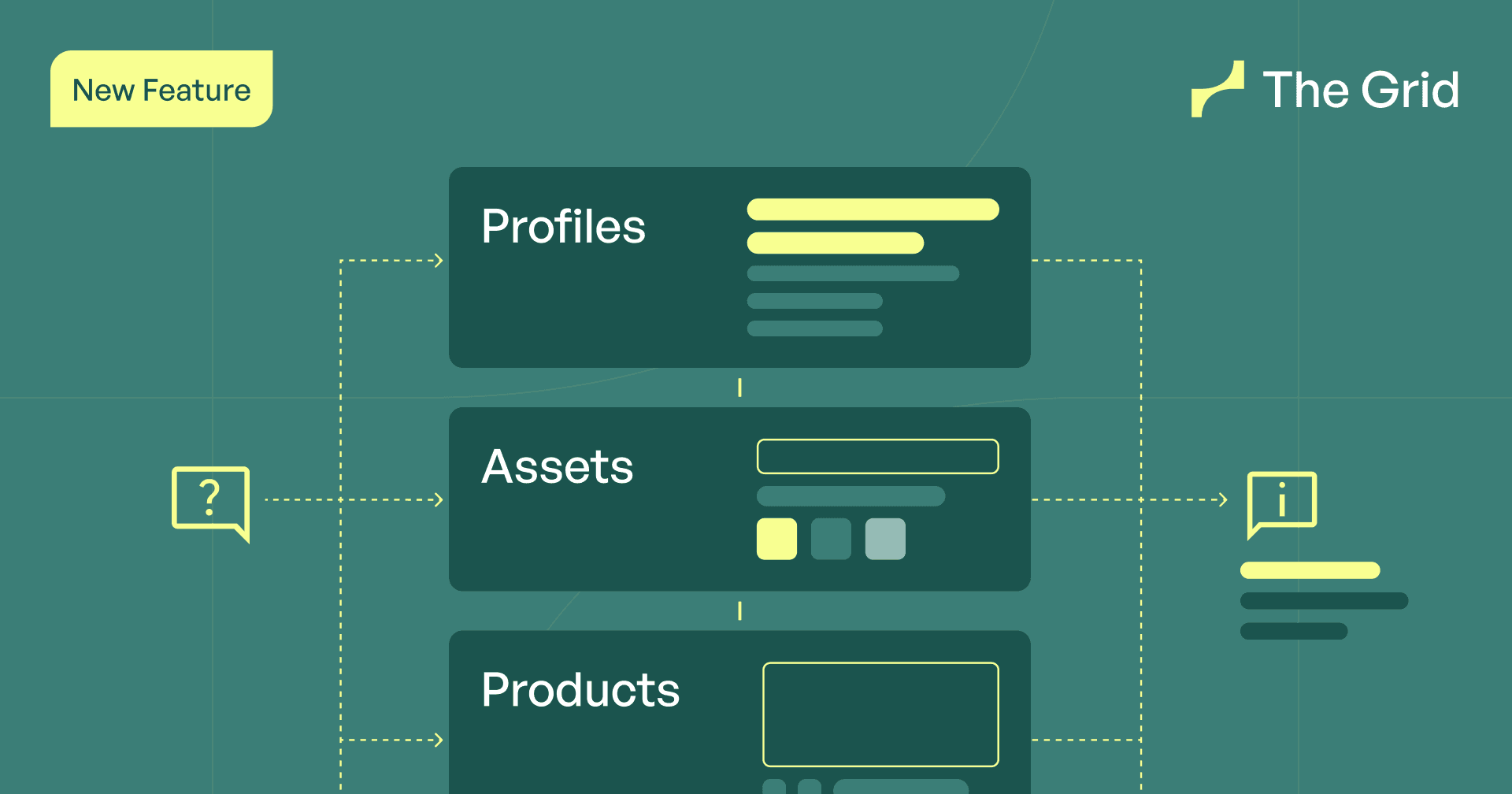
The Grid's knowledge graph covers the full Web3 stack across thousands of protocols. Agents can query:
Profiles: company and protocol identities, gridRank scores, sectors, founding dates, and status.
Products: DEXs, wallets, bridges, DeFi protocols, L1s/L2s, cards, and 100+ other product types.
Assets: tokens, NFTs, tickers, asset types, and on-chain deployments across 100+ chains.
Smart contract deployments: contract addresses, chain, standard, and deployment purpose.
Relationships: which products support which assets, parent-child entities, and ecosystem links.
Socials and URLs: social accounts and web links tied to any profile or product.
Metadata: verified flags (markers that confirm the data team has reviewed and validated an entry), logos, descriptions, and tags.
TGS: Our data schema.
Example queries you can run today:
"How many crypto cards support USDT?" returns a live count from structured product-asset relationship data.
"Which of those cards also support USDC?" cross-references the same dataset in one query.
“Find all active L2s with the highest gridRank.”
"Compare Uniswap and SushiSwap across products, assets, and deployments."
"Which bridges support both Ethereum and Polygon?"
Use cases
Developer co-pilot
This was the first use case the internal team discovered. Writing GraphQL queries against The Grid's API by hand requires precision. One malformed field breaks the whole request. The MCP removes that problem entirely. An LLM paired with the MCP can test queries against The Grid in real time, iterate on results, and build integrations without a developer needing to learn the schema.
Trading bots
Trading bots need to confirm which assets are legitimate before acting on them. The Grid returns verified smart contract addresses for assets like $ORCA, checked and maintained by the data team. A bot can query the canonical contract address for any tracked token and confirm it against what a counterparty claims, before a trade executes.
Data-driven content
The internal content team uses the MCP to pull specific data points for articles and market reports. Ask the agent, get structured results, cite directly. No manual profile checking.
Ecosystem and event directories
Clients building custom directories for blockchains or events can query profiles, filter by type, and tag by sector without touching the API directly.
Due diligence
Research teams can pull structured metadata for any protocol in the dataset: chain deployments, asset relationships, verified status, and sector classification.
Data validation
Teams use the MCP to surface inconsistencies fast. Missing fields, mismatched asset support, and outdated status all show up without manual reviews.
Competitive research
A venture fund evaluates dozens of projects at any given time. With the MCP, an analyst could describe a project under review, and the agent would pull every comparable protocol, product, or infrastructure layer already tracked in The Grid. Sector classification, gridRank scores, deployment chains, and asset relationships all come back in one query. What used to mean hours of directory browsing takes a single conversation.
Why The Grid's data
The Grid maintains one purpose: to produce the most accurate, structured, and comprehensive source of truth for the Web3 ecosystem.
A dedicated data team maintains every profile, product, and asset. The team processes new announcements within seven days. Data quality targets a 99%+ validation success rate. The dataset covers thousands of products across 100+ chains, all classified by TGS (The Grid Schema), a schema the team has refined over the last 2 years and will continue to refine based on feedback.
The MCP now registers as a tracked product type within TGS itself. That means The Grid's own infrastructure appears in the dataset it serves. That tells you something about how seriously the team treats schema coverage.
Get started
Install: Full setup instructions for all agents at thegrid.id/mcp
Compatible with: Claude Code, Claude Desktop, and any MCP-compatible agent.
Feedback? Let us know.
Resources:
No authentication. No rate limits. Free to use.
A quick example:
You: "Find all active crypto card products and tell me which ones support USDT and USDC."
Agent: Queries The Grid via MCP and returns a structured list, including Bybit Card, Crypto.com Visa Card, and Gnosis Pay, with asset support data per product.
You: "Which of those also support Solana?"
Agent: Cross-references deployment relationships and filters the result. No re-querying from scratch.
Research that used to take 20 minutes of tab-switching now takes a conversation.
What comes next
The Grid Bot (Telegram) and Discovery already run in production. The API powers directory products and ecosystem clients. The MCP adds the AI-native access channel to that set of tools.
The skills package, reference data, and dataset coverage will all expand. Build something with it, or spot data gaps and errors. The team wants to hear about it.
Start querying at thegrid.id/mcp