Resources
The Grid Year Two: Write Once, Read Everywhere
As The Grid travels furthers down our path, it is important to note that we work based on feedback. So reach out to us. We are just getting started :D
Written By
Jonathan Knegtel
Date
Category
Product
Length
In a time when it feels like there is an exodus of people from Web3, just as in every bear market, we see macro factors at play that are like nothing we (or any of us) have ever faced. As a market or as a species.
If there is anything I hope you get from The Grid, it is a reminder that the Web3 stack is better integrated than ever into "meat space" and we are bringing the data, let the migration begin! We are very proud of the fact that our data is already being consumed by some of the largest players in Web3, such as Tether and Solana.
As The Grid travels furthers down our path, it is important to note that we work based on feedback. So reach out to us. We are just getting started :D
With the end of winter and the coming spring in the Northern Hemisphere, it’s a time of both reflection of the past and a look at what we’re growing and building in the future. So here’s what’s been happening since we launched our beta endpoint, a reflection of how we evolved since we started two years ago with building The Grid, and where we're going.
For starters, we've updated our purpose:
Make Web3 useful, visible, and actionable: not just speculative.
We still believe in Web3, and helping us all to deliver on that potential to solve real world problems is why we spend all our time building The Grid. This renewed purpose reflects that vision.
Past Present Future
Looking back: Where we’ve been since launch of our beta endpoint:
We’ve focused on usability of the data for both machines (including AI) and humans
We iterated and improved our open source explorer for simpler directories, and then took those learnings and launched our Discovery Portal (now on thegrid.id). Discovery increased our surface area (indexing on SEO, site traffic by humans, bot activity, AI indexing) and is becoming a tool many people use to research what’s happening in Web3.
Built and launched GLEB, or “Grid LLM Enrichment Bot” (our first internal AI), which supports our (human) data research team in our data review pipeline.
Rebuilt our front end data editing component system, which benefits both our internal data admin (for our researchers) AND helps us in achieving our goal of providing an “Airbnb quality” level of UX for our Network Portal.
Introduced GridMCP which helps AI interact with our GraphQL endpoint to bring ecosystem data into existing tools and workflows with AI.
Overhauled our asset descriptions as part of an upcoming launch with Codex for our asset data to be distributed via Codex out into the industry.
Launched a lot of fun things with our data, including GridBot (query data on the fly while you network at conferences) or fun interfaces for our data, like a dating app or a trading card / video game explorer.
Looking around: Where we are now
We are onboarding profiles into the V3 of the Network Portal!
In the final stages of testing our Data Maintenance system, which helps increase our speed of (proactively) finding updates of profiles on The Grid.
Thanks to TGS10 we can add new data attributes into our dataset to be a one-stop-shop for key ecosystem data Bluechip ratings are now live and also ChainIDs.
Looking ahead: Where we’re going
TGS, our schema, is constantly growing, improving, and iterating. We’ve been improving all of our descriptions and adding more and more data fields.
We’ll be aggregating more metadata APIs into our network, and incorporating more industry standards (DTIs, LEIs etc) into our data structure.
Major improvements to GridBot to give a boost to networking in the upcoming conference season.
Further developing our MCP to then launch 'GridAI' - a side car to our Discovery experience so you can do more with the data and get insights faster. X402 anyone?
The above is just on the technical side, on the business side, we’ve also:
Audited and mapped the Tether ecosystem to support Tether with the launch of usdt.directory and some others in the works!
Built directories and supported events like Proof of Talk, European Blockchain Convention, and Solana Breakpoint & Accelerate.
Refined from metadata to ecosystem intelligence as we get more feedback from our users about the kinds of reporting and tools they want to help grow their ecosystems.
Just a quick note - we still view ourselves as being in open beta, because we are setting the bar very high for the kinds of data, insights, and utility we want to bring to Web3, and we are very much in builder mode.
What’s still here since the beginning
Our Commitment to Open Data with an Open Core
We believe in giving back to the ecosystems we serve with public goods, since the beginning. We've now released our open data service, which is a key part of our open core model. This isn't just about sharing; it's about creating a feedback loop. Our open-core approach means the tools we build will always have a foundation that's accessible, auditable, and open for collaboration, and that everyone in every blockchain ecosystem can benefit from the data we collect and validate.
TGS and its evolution
TGS, The Grid Schema is like the veins of The Grid. It outlines the structure of how data is saved and served out for The Grid. We have no idea where this will end up or how big it will get, so we are still building with some fundamental assumptions in mind:
To generally connect profiles together with loose 'relationships' that allow for feedback and improvement of the data over time.
We build TGS to be a “standard of standards” so that we complement the great work that others are doing in bringing more standardization for information in Web3 and have more and more of it accessible all in one place.
We have TGS available via our GraphQL endpoint to facilitate easier access to the underlying schema for all our data. And we’re still committed to evolving TGS over time (we’re already on TGS10) with the long term view that…
… We still build as a node
The Grid's endpoint we consider to be a node. A single node is not a blockchain. We are not kidding ourselves here. We consider ourselves focused on the schema (TGS), a schema that one day will be owned by the global ecosystem that we serve. Over time we believe that many data companies will all collect data to a shared schema in a verifiable credential use case, and TGS is the start.
We’re still headless
We made a large update to thegrid.id with our Discovery portal, which resulted in some real bumps in traffic since we got started in September. Data as of 10th March.
Google: 1.36M impressions and 3410 clicks
OpenAI: 600k scrapes of our site in 2026 (someone tell us why this is ok?)
X: 100k+ impressions, a 7.9% engagement rate, and 9.6K engagements.
We are now serving over 1M API requests a month!
On Discovery, the top profiles are getting serious love. Solana leading with 17k total views via AI, followed by Ethereum and Bitcoin
Why did we prioritize having our own optimized directory? Short answer: we needed to show our work so that people can understand the value of the data. We received feedback that we were not visible, and “if our data is that good why is it not coming up in more places like Google or cited by AI?” So we shifted strategy and took our existing open-source explorer, which was client side based, and made a server side rendered version, and started the journey of optimization for humans and machines, such as with pages by product type.
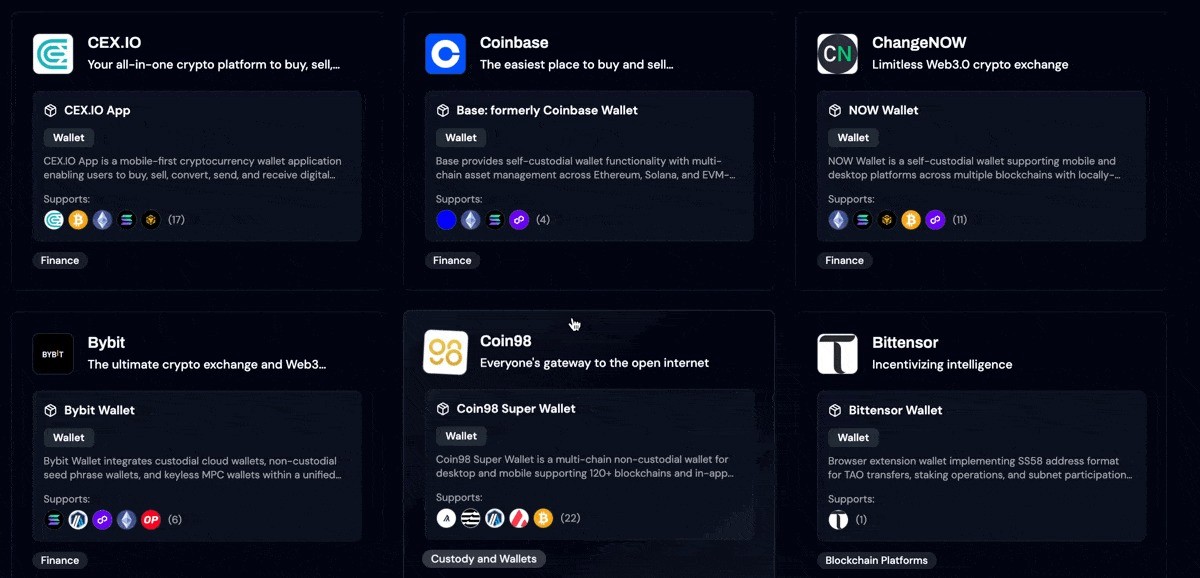
This called into question a core assumption we held: We cooperate and not compete with our clients and the ecosystem for traffic and attention.
That’s still our position because:
The goal with tools like Discovery is that we want our data to act as a canonical source.
We’re not running ads or pushing other content to drive traffic like a news site might do to monetize - we want people to be able to explore the data and to use it in tools they already use (like AI).
We’re not competing for rank in search results - anyone can build (see our Open Data core), combine this data with other content, and outrank us.
Similarly, we only show data from our own endpoint on Discovery.
To help orgs use our data, we also must use our data. Dogfooding your own product!
Our goal is to inspire our API users and clients, not compete, and to help everyone get further distribution and visibility out there.
We are still a headless data provider. Our roadmap for 2026 is to increase the distribution of our data through tools and partnerships, to continue to bring our data into the apps and tools people already use. As they say, a rising tide lifts all ships. And that brings us to the Network Portal.
The Network Portal: Our future
We are now on V3 of the Network Portal, and it’s evolved beyond a place where you can simply 'put in data' to being the root of our north star metric: MAP: Monthly Active Profiles.
So with MAP, the question naturally became, how are we intending to bring people back after they claim their company’s profile?
There are 100's of directories online that ask businesses to submit information (into a silo) to be listed or updated. In Web3 this means tons and tons of Google Forms or Airtables. That’s building a serious problem for all of us, as once you make an update, what are each of us going to do? Go back and re-submit all those different forms and Airtables again? How do I even remember which ones I filled in? Each time feeding a 'data black hole' that creates multiple data silos, which is the very thing that our industry works against.
That’s why we always pitch The Grid’s ability to "write once, read everywhere" as the key benefit for claiming a profile with us. You can also see your full change history, just like you can see transactions on a blockchain…. (you can see where we are going…) We still check every data edit by hand with our four eyes principle to ensure data quality and have no plans to change that.
Big picture, when you start to peel back the layers behind platforms like X and LinkedIn, they have data companies at their core. You have the concept of a "profile" that has an "identity" in relation to each business. You often can post into a feed and interact with content from other profiles/businesses, or even message them.
When applying this to The Grid, we opted to lean into this because when you look at how Web3 does BD, the current state simply can't be the status quo for the coming decade.
Thus our network vision:
Imagine logging into The Grid, seeing a feed of updates of the tools that you rely upon or follow, being able to search and learn about other profiles. Want to connect with them? Just send a connection request and you get connected to the relevant team or department currently working there.
So why publish data in The Grid?
Other platforms are all “un-structured” updates. You can post product information to LinkedIn, but this data remains isolated to LinkedIn, likely as unstructured data in a post. You may link to a blog post on your site that explains the changes in more detail, but still very unstructured.
We are moving towards a world where builders want the ability to post structured data updates that are not isolated in a silo, but rather can be consumed by anyone, which is in the benefits of us all. That vision of structured business information published and exchanged between builders and their communities is what we are building towards.
Let’s move together towards more accurate data, published and exchanged so we can all benefit and eventually move far faster and much further than we ever imagined.
Claim your profile to get started at network.thegrid.id (we hope you enjoy the onboarding VS “yet another” form).