Resources
TGS11 Is Live: Country Support and GridRank Updates
TGS11 launched inside The Grid Schema. This release adds country support information for products listed on The Grid. The new data point records the countries where a product operates, ships to, or provides support. The release also updated GridRank.
Written By
The Grid Team
Date
Category
Product
Length
To see our TGS changelog, go here. To explore TGS in full, or to pass it to your LLM, see it in json, YAML or markdown.
Where This Came From
Two sources drove our country update.
The first came from a direct customer request from Tether. Their team runs a partner directory built on The Grid’s data, and they needed to filter products by region, starting with Africa, to identify which partners actually serve specific markets. Country of registration alone could not answer this. A company registered in the UAE might primarily service African markets. A company registered in Singapore might operate across South-East Asia and parts of the Middle East. A directory filtering only by entity country misses both.
The second came from a recurring pattern in user feedback. People asking questions of The Grid, through directory products, discovery surfaces, and the API, wanted clearer answers about where products actually work. Country of incorporation does not answer that. A product registered in one jurisdiction can serve users in many others, or none. We added country support to close that gap.
The GridRank update came from a simpler need. The existing GridRank.score field assigns a simple number that climbs with each new profile connection, starting at 0 and rising on raw counts alone. That made it unintuitive. Users had to sort backwards, and the field caused problems both internally and for our users. The new gridRank.ranking field assigns the most connected profiles a rank of 1, 2, 3, and so on, much like an app store ranking.
Fun note for those that know SQL. We wish we could call it .rank but we just can’t. So is life.
Inside the Country Release
TGS11 introduces supportsCountries, a relationship table linking products to the countries where they operate, serve, or provide support. Each row represents one country association for one product. You can query the data from The Grid's GraphQL API, and it surfaces wherever The Grid's schema runs, including the explorer, discovery, partner directories, MCP, and the public API.
The release adds a regionId field to the existing countries table, linking every country to a parent region in the UN M49 hierarchy. This makes region-level filtering, such as "products available in Sub-Saharan Africa," work as a single clean query rather than a manually maintained list of country codes.
The data point applies to products connected to profiles on The Grid. A profile can carry multiple products, and each product can link to as many or as few countries as accurately describe its coverage. Both changes add to the schema without breaking anything, so every existing query continues to run unchanged.
What Directories Can Do With It
Directories built on The Grid can now give users clearer answers about where products actually work. Questions like "which wallets support users in Nigeria?" or "which payment products serve South-East Asia?" become answerable from structured data, not from inference or scraped marketing pages. Directory operators can filter by country, group by region, and present geographic coverage as a first-class attribute of every listed product.
What This Gives Listed Profiles
For projects and organizations listed on The Grid, country support provides a clean way to show where their products work. Profile pages can display supported countries directly, rather than relying on long-form descriptions or buried documentation. The information becomes part of the structured profile, so it surfaces consistently wherever The Grid's data flows, including discovery, partner directories, the API, MCP responses, and ecosystem maps.
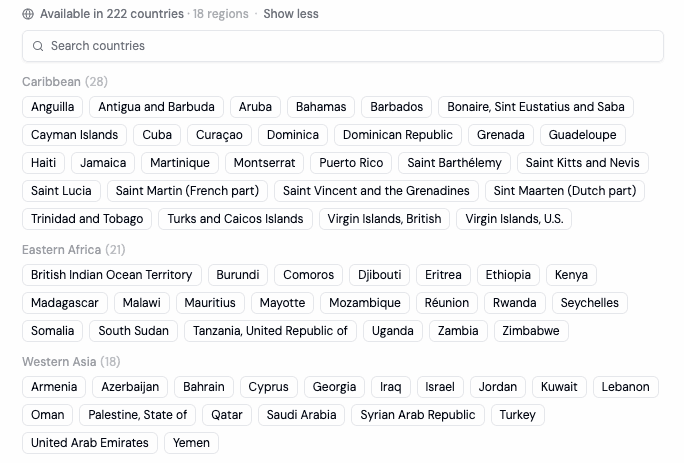
Here you can look at the products from Blockradar, one of our recently claimed profiles: https://thegrid.id/profiles/blockradar
From Schema to Surface
The rollout follows four steps:
TGS11 is live inside The Grid Schema. You can query the data point from the API today.
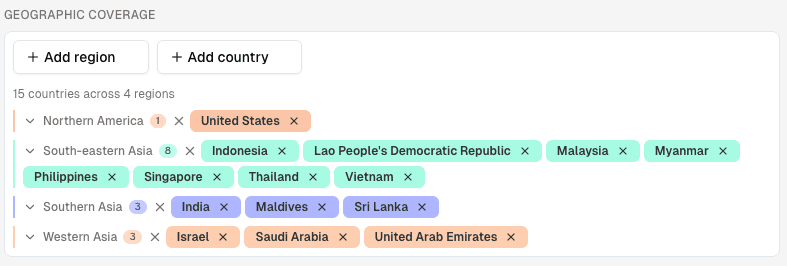
Profile claimers can add country support to their products now. Anyone with a claimed profile can log in, edit each product, and add the countries it supports. A dedicated geographic coverage section sits in the admin.
The Grid integrates country support into its owned channels, including the discovery experience and custom directories built for partners.
The data team will review and backfill existing profiles over the coming weeks and months, starting with the highest-ranked and working outward.
The GridRank update affects no existing implementations, and the old gridRank.score field stays available for now. To use the new ranking, query roots.gridRank.ranking.
If You've Claimed a Profile
If you have already claimed a profile on The Grid, you can add country support to your products now. Log in, open each product, and use the dedicated geographic coverage section to add the countries the product operates in, ships to, or supports. You can add, remove, or revise countries at any time.
The sooner the data goes in, the sooner your product appears in country and region filters across The Grid and the directories that use it, including customer-facing surfaces for active partners, such as usdt.directory.
The Wider Use Cases
Country support data opens use cases that a single source previously could not deliver cleanly:
Custom directories can offer geographic filtering as a default control.
Discovery experiences can route users to products that operate in their region.
Regional filtering becomes a structured query rather than a manual exercise.
Ecosystem mapping can show coverage gaps and concentrations across geographies.
Product data use cases, including compliance reviews, partnership scoping, and market analysis, can draw from structured fields rather than scraped pages.
Each of these builds on the same underlying data point, which means consistency across surfaces and across customers.
Built by Request
The Grid's schema evolves through numbered, backwards-compatible releases. New data points come from three inputs: user feedback, specific customer requests, and product design decisions about what The Grid needs to represent well. TGS11 reflects all three. The data team logged the geography work months before the release. A customer requirement accelerated it, and the broader pattern of user questions shaped its final scope. Geographic coverage ranks among the most frequent questions that The Grid fields.
Users often repeat the same questions. When a customer needs structured data that does not yet exist, The Grid extends the schema and rolls the change out across the stack.
What is GridRank and where is it going?
Anyone working with data needs a way to surface important profiles. GridRank does that. The plan is to expand it over time, pulling in more metrics and powering leaderboard-style interfaces. The goal is a reliable proxy for profile importance. The team will evolve it based on user feedback.
From Here
Country support data will grow in waves. The data team starts with the most prominent profiles to validate query patterns and surface any edge cases. Profile claimers can add their own data immediately, and an email reminder will follow to prompt those who haven't. The data team will review and backfill unclaimed profiles over the following weeks and months. As the dataset grows, country and region filtering will appear progressively across The Grid's discovery experience, the directories built on The Grid, and the API.
The dataset will deepen quickly once the claimer campaign goes out, and will keep deepening as the backfill progresses.
Where to Start
Profile claimers: log in to The Grid, find your products, and add the countries each one supports. If you haven't yet claimed your profile, claim it first.
Directory operators and ecosystem teams: you can query country support from the API now. Get in touch if you want help integrating geographic filtering into your directory or discovery surface.
Developers and data teams: the live schema sits at tgs.thegrid.id. The supportsCountries table and the updated countries table appear there with full documentation, ready to query.
Researchers, analysts, and end users: expect country and region filters to start appearing across discovery surfaces and partner directories in the coming weeks. Coverage will grow as the team claims, updates, and backfills profiles.
—————
The full TGS11 data points (including GridRank) are available under subscription from The Grid. If you are interested in implementing The Grid's data in your organisation, please get in touch.