Resources
TGS: The Blueprint Behind The Map
I’ve previously written about the importance of good data being vital, the evolutionary potential of blockchain, and why, for the Web3 ecosystem to expand, we need a map.
Written By
Jonathan Knegtel
Date
Category
Insights
Length

In this article, I’m going beyond why I think that The Grid is the map that we need, and explain how we’re building a foundational blueprint for a mode of ‘meta-’standardization that can support the Web3 ecosystem to the next stage of adoption.
The Need for Standards & Schemas
Many of us (if not most of us) working in Web3 believe in the benefits of decentralized systems. It’s a big part of why we work in this industry. If you look around today, the pieces for blockchain to live up to its full potential are all there. But to do this, we need to scale adoption.
Block space is not the problem. We have enough block space. To grow to the point where the industry can become a true alternative to the conventional transaction systems of the past, we need people to find and use things that solve their problems. A big part of this comes down to, can a user get informed on how something can be used in a simple way? Can they make sure it is compatible with what they use?
Currently, a product can be categorized in various, often contradictory ways in Web3. Or it just tells you about its token, not how you can use it. This creates confusion and uncertainty. Each ecosystem in Web3 has been built according to its own map, developing its own taxonomy. Each profile is then represented in different ways which causes a bad UX. You can’t build a functioning, scalable city if all the map apps share different routes / business names. That’s just chaos.
For Web3 to grow, we need a shared way of communicating about what’s happening off chain. Standards can help do this and there are many of them. Different regulations are also different standards in their own right. But today, many of these standards are not enforced, not adopted and simply messy. Giving one standard example, the DTI from the DTIF was meant to solve the problem of unique token identifiers, however global adoption of this has been slow and not universal. It is unclear to industry insiders on how this is coming together and where it is being adopted.
At The Grid, we’re throwing the idea of a standard out of the window. We are building a data system that can act as a map to other standards. Not only that, but we intend to ingest those other standards, leading to a canonical source of how things connect. We will use that to inform aggregate information about ecosystem participants and work towards helping them publish data to various standards. We call that TGS.
We all know the XKCD comic about standards. The reality is that it’s more than standards at this point; it's also about regulation and differences in how businesses think about Web3. We are working to be simple and agnostic to how the industry and business identity evolves.
The Grid Schema
TGS, or The Grid Schema, is our data schema for Web3. Made up of tables grouped together in lenses, TGS is essentially a way to describe any business or shop. Each lens shows whether the ‘shop’ has its own issued asset, what its different products and/or services are, and its entities. The lenses aim to provide a simple way to to group information about profiles on The Grid.
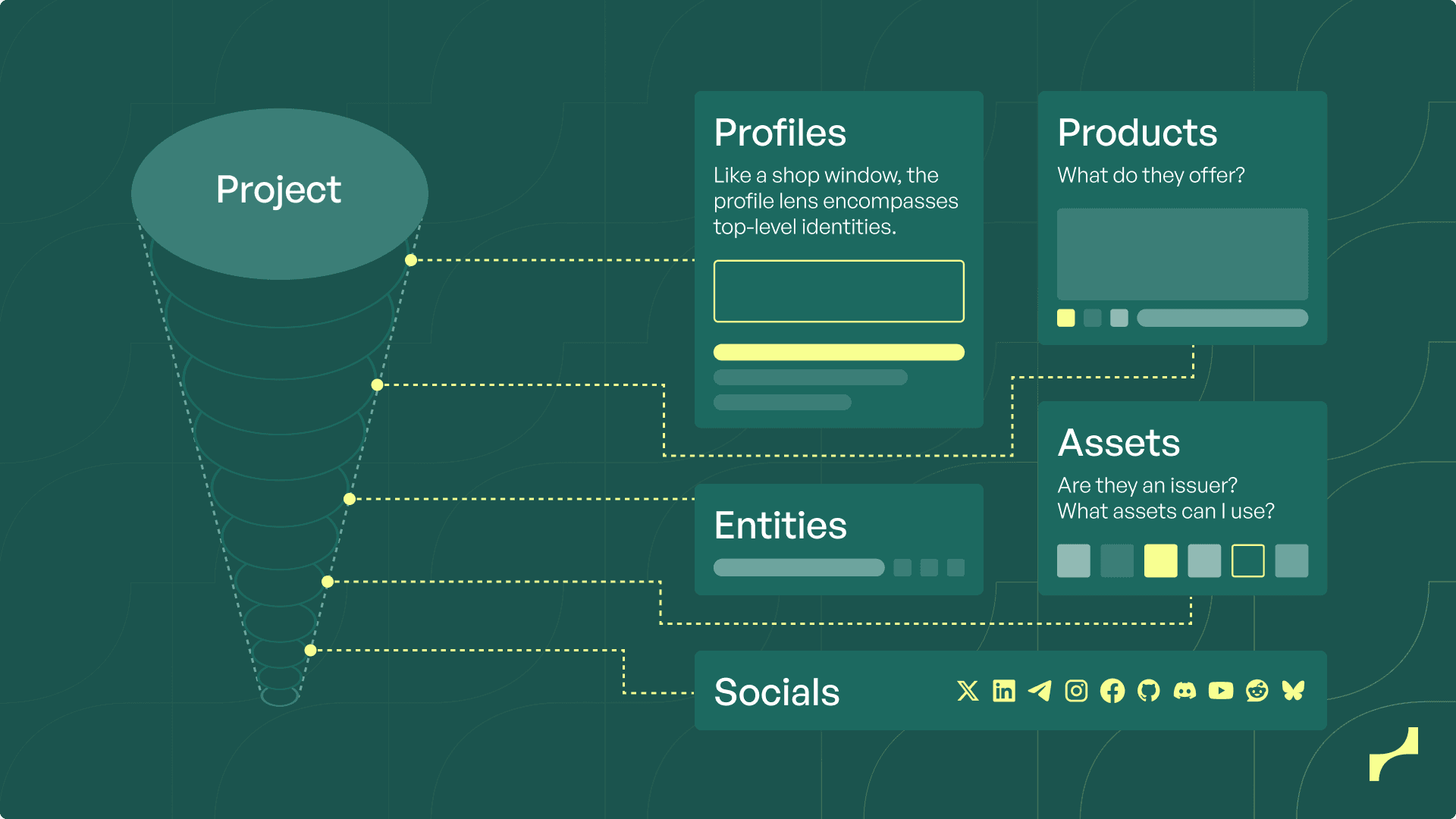
If I have a smart/token contract address on a blockchain, it may provide very basic information as you can see everything happening on-chain. But, more often than not, you cannot find context and detail on what that asset does, which products it can be used in etc. This is where TGS really comes into its own. We have specific elements designed for how these things link together, showing how products link together, or whether there’s a smart contract, or where it exists on the blockchain. The goal here is that it does not matter what UX a user is looking at, be that a retail user simply trying to find a tool or a business trying to do DD on a project.
On TGS, you can see beyond smart contracts to everything else a company is doing: how their products link together, their additional services, activity, and other information that adds to the overall credibility of the company. Because if we’re talking about using or investing, you want to have a solid view of what it is that you’re actually using or investing into.
Improving Credibility & Understanding
Anybody can deploy another contract on Ethereum, and give it the same name as a more established company or trending token. Scammers are able to take advantage of this, which is why getting adoption of standards now is so important. For Web3 to thrive as an independent, alternative system, the blockchain world needs more credibility. Accurate, real-time data – and not just about what is happening on-chain – is essential.
Lots of projects in Web3 just die with their directory or tokenpage information, and past activity hanging around is like camouflaged tombstones, posts in channels asking “is this still active” their only eulogy. That leaves all of us, including incomers to Web 3, trying to engage with inactive projects and wasting everyone’s time and money. If a new user of blockchain ends up wasting their time or participating in a scam project, they will ‘churn’ and probably never return.
But with TGS as a ‘meta-’framework, we are moving towards real-time updates regarding regulations or real-time hack information so a user, no matter where they are, can see recent accurate information. Because if something has been hacked, we don’t want other users to engage with them. We want to be the organization that fields and maintains that kind of information, in all the different maps, and potentially exposes weaknesses in systems that need to be fixed or addressed.
Why TGS is Important Now
It is inefficient for anybody using a map to ask for this kind of information from AI data systems, because this kind of information is generated on the fly. In Web3, we need data structures that can be accurate and available at any time, and accessible to anyone who needs or wants it. Google maps does not work if it generates all the data about businesses, every time, from every website. Even then, some data does not even live on the website.
Unlike AI tools that go out and scour the web for information, and then rake in all the beach glass and flotsam alike, TGS provides a kind of guardrail, structuring a company or project’s data so that it can be discovered and made discoverable in the most convenient way.
Say a blockchain project comes to TGS to structure their data. That information then gets distributed to where they can potentially get users. It’s a similar (but more advanced) means of categorization to toggling Google Maps to show only restaurants, or gyms in a certain radius: it’s not useful to be shown a nice-looking cocktail bar 5 hours away when you’re actually looking for a hairdresser in your neighbourhood.
Evolving According to User Needs
TGS evolves according to the needs of its users. Our latest update, TGS 11, developed in response to the efficiency and globalization of Web3, links products to countries as well as regions. For instance, if someone in Nairobi wants to use stablecoins, if the map can’t help answer which products are supported in Nairobi, then they hit a dead end. This is where The Grid as a map transforms from metaphor into reality. We did not introduce it on assets yet, but this is an example of how we are keeping our options open.
TGS enables people in Web3 to build interesting things from our data: so we want the information we display and provide to be shown in the places that people already use. Many blockchain companies have built super interesting products, but people aren’t using them. And while we’re not saying that TGS is going to suddenly bring a tonne of people to Web3, it does bring clarity to an area that is often seen as mysterious or confusing by those not in the thick of it. As we are working with major stablecoins, our focus is currently on that.
The Grid is designed to be collaborative, so that projects can adjust, change, and update data over time as the industry grows and changes. And TGS is increasingly user-driven. Not only can people in Web3 build interesting things from our data, but over time we will create a voting system for users to decide on what future developments they’d like to see, or changes to certain types. For instance, if we add a product region to a core landing page on TGS, users can come and upvote it if they like or need it.
We’re also introducing greater data editing capabilities. We can now set up different views for different companies across any subset of our data for our clients. Once a profile is set up, thanks to the underlying infrastructure, data can be updated in mere minutes.
What TGS Enables
There is no one definitive UI at The Grid: this is by design. We’re not the shop: the applications that show our data are. The UI is adaptable for users to gather/display all the information they need. For every datapoint, we have a description and recently updated thegrid.id/tgs. We show the company, the location, the products – including which countries the product supports – the deployments, and the profiles.
In The Grid Directory, users can also customize their profile theme to cohere with their own branding, as well as adjusting the views available. Essentially, we’re helping organizations to set up and customize their own form of Google Maps, branded and built to suit their own particular audience.
You can check out some of our UIs here:
thegrid.id → Our main experimentation page which acts as the front-facing site
grid.thegrid.id / grid.thegrid.id/board → A tinder-like experience and board view
map.thegrid.id → an MVP for visualizing project location data
Looking Forward
In the long-term, we want users of The Grid to participate in the governance of the schema. We are inviting feedback from our community, ensuring that we grow in the ways wanted and needed by our users. For now, just let us know.
So, consider this our townhall speech. We’re opening the floor to you, to organize drop-in sessions where our users, colleagues, friends, or curious bystanders can come by and yell at us or sing our praises.
TGS will never be finished: it will never be done. We know that it’s not perfect yet – nothing ever is – but we want to improve it, and the only way we can do that is by listening to and acting upon the feedback that people give us. So please: give us feedback!